By Journal of The Electrochemical Society | 25 March 2026 | 0 Comments
BYD FC4680 3.2V 15 Ah 4680 High-Energy LFP Battery Cell
LFP cylindrical lithium ion batteries are common in micromobility applications (i.e. Electric bikes, Electric scooters, etc) and consumer power tools, they remain rare in EV and EES applications, where prismatic LiFePO4 battery cells and NCM prismatic battery cells are typically favored for having higher energy per cell and ease of battery pack assembly.
Can the BYD FC4680P lithium iron phosphate battery cells fill the market gap for high-capacity cylindrical battery cells? This article will briefly introduce the basic information about this battery cell and see if it can meet market demand.
In contrast to the Li-ion 4680 battery cell, which uses NMC chemistry for higher energy and power demands, the use of LFP in a large cylindrical format over the more common prismatic format carries implications for the BYD 4680's power performance.
The BYD FC4680P 4680 cylindrical cell is insulated with an outer sleeve.
This battery cell includes a small pressure relief valve located next to the cathode terminal.
BYD FC4680P's can material is nickel-plated steel, which serves as the negative terminal.
BYD 4680 battery cell's dimensions: 80 mm (height) × 46 mm (diameter).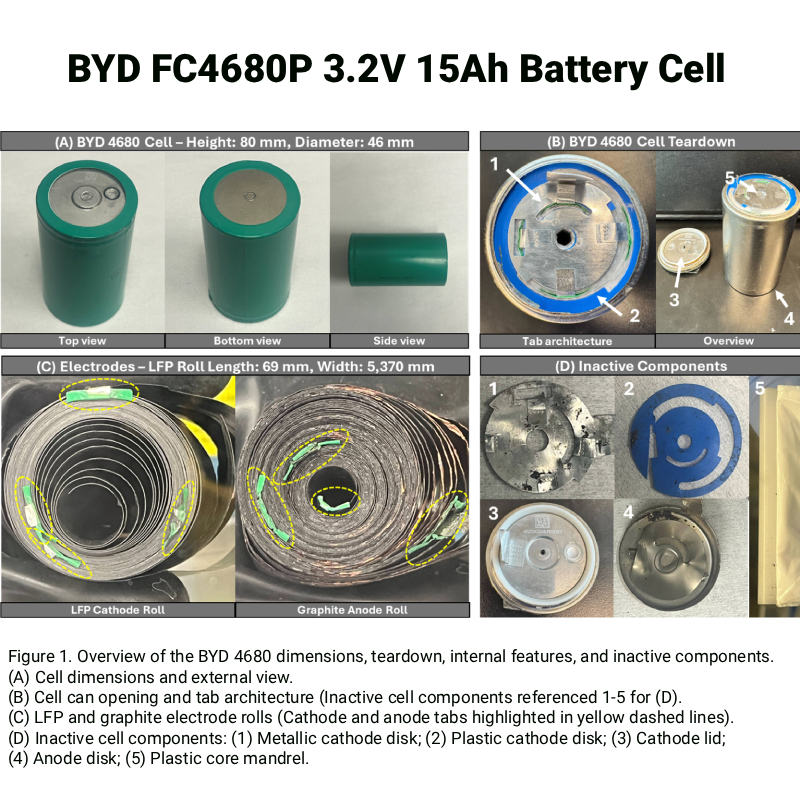
As highlighted in yellow, the LFP cathode roll includes four separate aluminum tabs, whereas the graphite anode roll has three separate nickel tabs. These tabs run along the length of each electrode. A multi-tab architecture is expected to alleviate internal resistance and improve current distribution uniformity, a more crucial parameter when considering the design of larger format cells.
BYD 4680 battery was subsequently charged and discharged at the same C/5 rate between 2.8V and 3.65V. and it delivered a discharge capacity of 15.41Ah and a discharge energy of 49.82Wh
Based on the measured weight and volume of the BYD 4680 cell, the gravimetric and volumetric energy densities were calculated to be 151 Wh kg
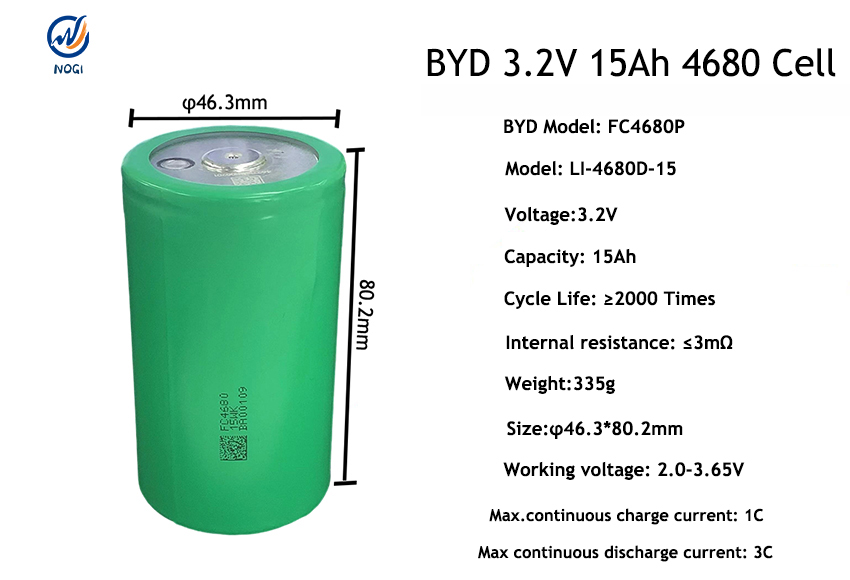
The 4680 cell format marks an exciting evolution in cylindrical cell design and makes it fit for both EV and EES applications. As a major cell producer, BYD introduces a distinctly different approach from the lithium-ion 4680 battery, featuring a unique multi-tab configuration and mandrel-supported architecture. This work not only demonstrates the viability of LFP in high-power cylindrical formats but also establishes a valuable reference point for future innovation. It identifies opportunities for further investigation, including thermal behavior and cathode surface engineering, and sets the stage for advancing cylindrical lithium-ion battery technology beyond traditional boundaries.
Some content is from:https://iopscience.iop.org/article/10.1149/1945-7111/ae1e33
More details of lithium ion batteries, please contact us by:
Wechat/WhatsApp: +8613528488114 Email: sales@nogibattery.com
Website: www.nogibattery.com
What is a Semi-Solid State Battery?
Battery Upgrade for Mitsubishi i-MiEV: Replace LEV50 battery with CATL 3.7V 93Ah battery Cells
Leave a Reply
Your email address will not be published.Required fields are marked. *