Little knowledge of lithium battery PACK
Practical information. Little knowledge of lithium battery PACK
Foreword: Since its inception, lithium batteries have been favored by 3C digital, power tools and other industries due to their advantages of high energy density, high voltage, environmental protection, long life and fast charging, and their contribution to the new energy vehicle industry is particularly prominent.
1. Basic introduction of battery PACK
New energy vehicle three-electric system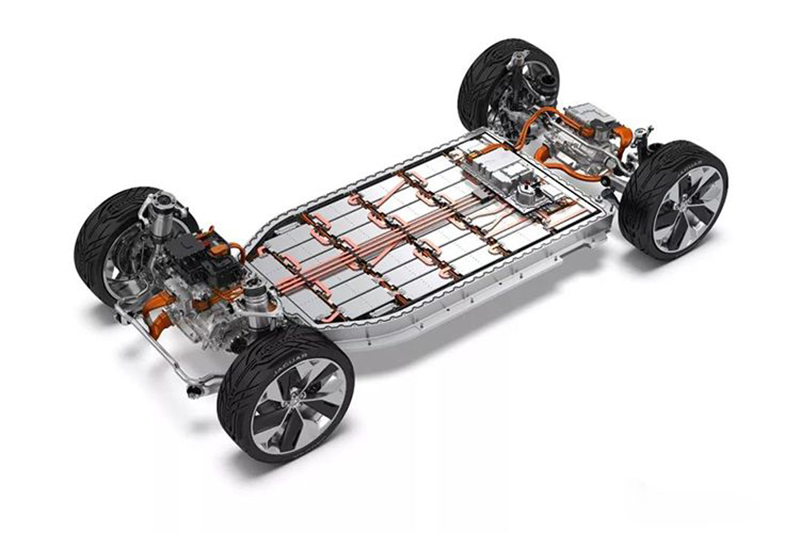
Battery PACK and chassis integration
2. Classification of battery PACK
What is a battery PACK ?
First of all, it is necessary to understand the general distinction between lithium battery cells, lithium battery modules and lithium battery PACKs:
Battery cell (cell): the most basic element that constitutes the battery PACK and battery PACK, generally the voltage that can be provided is between 3v-4v;
Battery Module (Batteries): a collection of multiple monomers to form a single physical module, providing higher voltage and capacity;
Battery PACK (PACK): It is generally composed of multiple battery modules. At the same time, a battery management system (bms) is also added, which is the final product provided by the battery factory to the user.
Composition and classification of PACK
As the core component of PACK, battery cell are currently classified into three main categories according to the shape of the batteries: Prismatic Cell, Cylindrical Cell, and Pouch Cell (polymer batteries). The positive and negative electrodes are encapsulated into corresponding casings in different ways.
Left cylindrical winding Middle-Prismatic winding Right-square stacking 
Left-cylindrical cell Middle-Prismatic Cell Right-Pouch cell
Battery Module
By assembling a single cell, the cells are formed into different series and parallel through the bus bar, which can be screwed, resistance welding, ultrasonic welding, ultrasonic aluminum wire welding and laser welding.
Taking into account the production yield, efficiency and internal resistance of the connection point, laser welding is currently the first choice for many battery manufacturers.

Left-cylindrical battery module Middle-Prismatic battery module Right-Pouch battery module
Battery PACK 
Left - Cylindrical battery PACK Right-Prismatic battery PACK
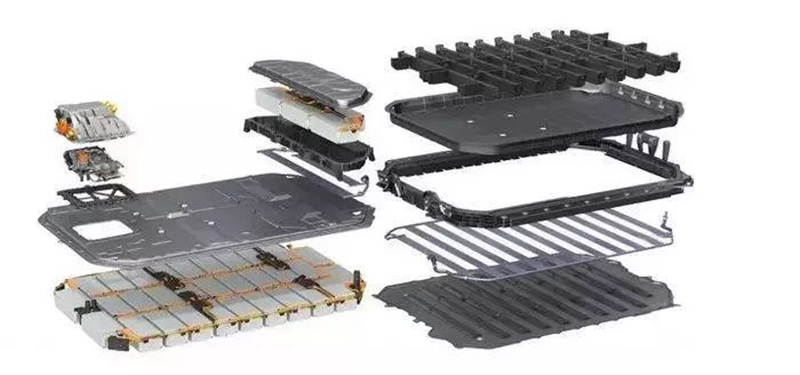
Pouch battery PACK
3. Composition of battery PACK
Battery PACK mainly includes several parts of battery module, mechanism system, electrical system, thermal management system and BMS.
Battery module
If the battery pack is likened to a human body, then the module is the "heart" responsible for storing and releasing energy to power the car.
Mechanism system
It is mainly composed of the battery pack upper cover, tray, various metal brackets, end plates and bolts. It can be regarded as the "skeleton" of the battery pack, which can support, resist mechanical shock, mechanical vibration and environmental protection (waterproof and dustproof). effect.
Electrical system
It is mainly composed of high voltage jumper or high voltage wiring harness, low voltage wiring harness and relay. The high-voltage wiring harness can be regarded as the "large artery" of the battery pack, which continuously transmits the power of the heart of the power battery system to various required components, while the low-voltage wiring harness can be regarded as the "neural network" of the battery pack, which transmits detection signals and controls in real time.
Thermal management system
There are four main types of thermal management systems: air cooling, water cooling, liquid cooling, and phase change materials. Taking the water cooling system as an example, the thermal management system is mainly composed of cooling plates, cooling water pipes, heat insulation pads and heat conduction pads. The thermal management system is equivalent to installing an air conditioner on the battery pack.
BMS
BMS: Battery management system, which can be seen as the "brain" of the battery. It is mainly composed of CMU and BMU.
CMU: Cell monitor Unit, which is responsible for measuring parameters such as voltage, current and temperature of the battery, as well as functions such as balancing. When the CMU measures these data, it transmits the data to the BMU through the battery "neural network" mentioned earlier.
BMU: Battery management Unit battery management unit. It is responsible for evaluating the data transmitted by the CMU. If the data is abnormal, it will protect the battery, issue a request to reduce the current, or cut off the charging and discharging path to prevent the battery from exceeding the permitted usage conditions, and also manage the battery power and temperature. According to the previously designed control strategy, the parameters and states that need to be alerted are judged, and the alert is sent to the vehicle controller, and finally conveyed to the driver.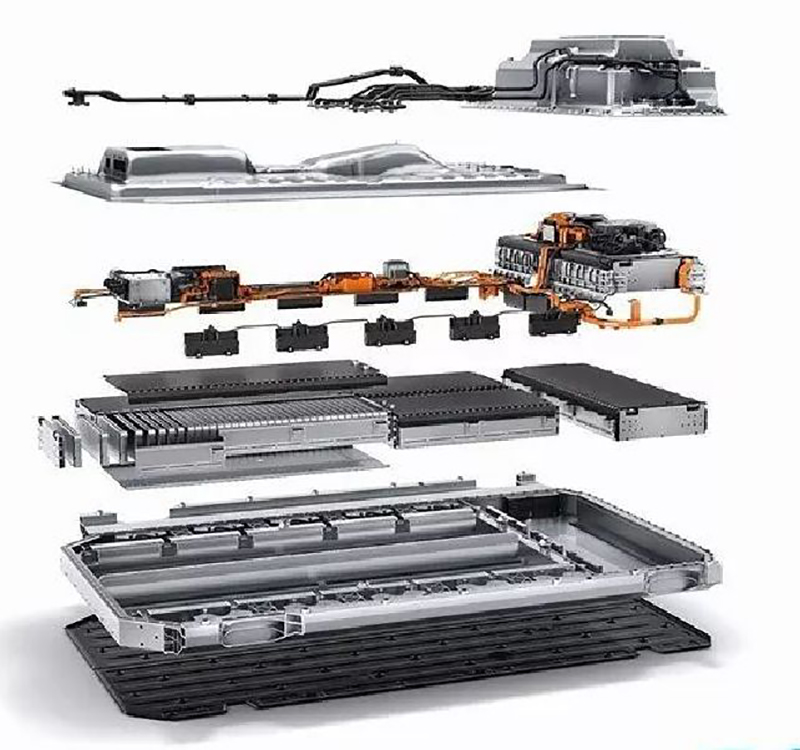
Exploded diagram of battery PACK
By Intuitive Mechanics
Battery Module
Battery Module
Battery MoBattery Moduledule